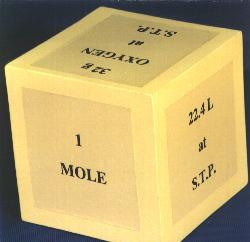
In Chemistry 11 we learned about gases and moles. the volume occupied by a certain gas depends on the temperature and pressure. STP the standard temperature and pressure that we are in right now is T = 0°C and the standard pressure is 101.3 kPa
The volume of any gas at STP is 22.4L for every mole
Ex. find the volume of L occupied by 0.060mol of CO2 at STP
0.060 * 22.4l/1mol = 1.3L
find the volume occupied by 3.6kg of fluorine at STP
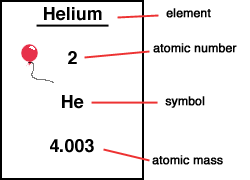
Today in Chemistry 11 we learned about Atomic Mass. -the mass of 1 mole of atoms of an element Ex. mass of 1 mole of "C" atoms is 12.0g mass of 1 mole of "Ca" atoms is 40.1g
Molar Mass - the mass in grams of 1 mole of molecules of an element or compound is the molar mass for the diatomics you would times there mass by two if there by themselves H2, Cl2, F2, I2, O2, N2, Br2, and same goes for the molecular ones P4, S8
Element Symbol Formula Atmoic Mass Molar Mass Bromine Br Br2 79.9 159.8 Neon Ne Ne 20.2 20.2 Silicon Si Si 28.1 28.1 Hydrogen H H2 1 2 Iron Fe Fe 55.8 55.8
For compounds add the molar masses of all the atoms Ex. H2O 2H - 2 1O - 16 H2O = 18g/mol
this number was created by Amedeo Avogadro. A pea of moles can cover all of the buildings in canada. Mr.Doktor also explained to us how to use the mole to balance equations.
Ex. 2 H2 + O2 = 2 H2O
2 molecules + 1 molecule = 2 molecules
12.04 x 10 power 23 + 6.02 x 10 power 23 = 12.04 x 10 power 23
2 moles + 1 mole = 2 moles
Avogadro also had a hypothesis and that was: Equal volumes of any gas at the same temperature and pressure contain equal numbers of molecules.
We also learned about a man named John Dalton and how he used masses of chemicals to look for a patter in chemical reactions.
What he came up with were :
11.1g of H2 reacts with 88.9g of O2
46.7g of N2 reacts with 53.3g of O2
42.9g of C reacts with 57.1g of O2
Which there was no pattern.
And we learned about a guy named Joseph Gay-Lussac he also was looking for a pattern in chemical reactions by using simple ratios.
He came up with:
1L of H2 reacts with 1L of Cl2 = 2L of HCl
1L of N2 reacts with 3L of H2 = 2L of NH3
2L of CO reacts with 1L of O2 = 2L of CO2
Here's a youtube video explaining a concept of the mole:
-Solid, Liquid, or Gas SATP (Standard, Ambient, Temperature, Pressure) T = 25oC p = 100KPA -form conducting aqueous solutions -turn blue litmus red -dissolve in water to produce H+ -taste sour
Bases
-turn red litmus blue -slippery -non conductive -dissolve in water to produce OH-
Naming Acids
-acids are aqueous (dissolve in water) -hydrogen compounds are acids Ex. -HCl(aq) - Hydrochloric acid -H2SO4(aq) - Sulfuric acid -Hydrogen appears first in the formula unless it is part of polyatomic group Ex. CH3COOH(aq) - Acetic Acid -classical rules use suffix ic or prefix hydro Ex. Hydrochloric acid Sulfuric acid IUPAC uses the aqueous hydrogen compound Ex. HCL(aq) - Aqueous Hydrogen chloride
Naming Bases
-for now all bases will be aqueous -solutions of ionic hydroxides Ex. NaOH - sodium hydroxide BaOH - barium hydroxide
Today in chemistry 11 we learned about hydrates, how to name them, molecular compounds, and how to name them.
Hydrates
-compounds that form lattices that bond to water molecules -when there are no water compounds in a hydrate often preceded by anhydrous ex. copper sulfate -crystals contain water inside, it can be released by heating
Naming Hydrates
-write name of the chemical formula -add prefix indicating number of water molecules (mono, di, tri) -add hydrate after prefix -if something has more then one charge you can use ic at the end indicating a larger charge or ous indicating a smaller charge Examples: cu(So4Li - 5H2O8 - cuppric sulfate pentahydrate : Li(ClO4) - 3H2O - Lithium perchlorate trihydrate : Nickel (II) sulfate hexahydrate - Ni(SO4) - 6 H2O
You will also need to know your prefixes for naming hydrates and molecular compounds mono - 1 di - 2 tri - 3 tetra - 4 penta -5 hexa -6 hepta -7 octa - 8 nona - 9 deca- 10
Here's a video showing you how to name hydrates
Molecular Compounds
-composed of two or more non metals -low melting and boiling points -share (not exchange) electrons -usually end in gen ex. oxygen hydrogen nitrogen -7 molecules are diatomic (they are the same element) Ex. H2, N2, F2, O2, Cl2, Br2, I2 -2 of them are polyatomic Ex. P4, S8