Wednesday, December 9, 2009

December 4/09


In todays class we learned about Molecular Formula and we did a lab on dilution.

For the lab Mr.Doktor showed us 5 test tubes each that are different colors and we had to compare our test tube to the other 5 and pick one of them.

First we had to measure the amount of water we needed
Then do our calculations to get the amount of Copper (II) Chloride we needed
Then add our solution to the water and stir
Our last step was to pick the test tube that was the most similar to ours.

A Molecular formula is what the equation should actually be.

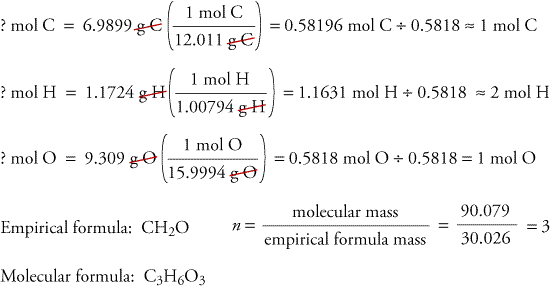
You will need to know the Empirical Formula before doing the molecular formula lets jut say our empirical formula is CH2O Molecular Formula which is getting the mass in the equation dividing it by the original molar mass and then just multiply the equation and use subscripts.

Example : CH2O has a molecular weight of 180g/mol find the molecular formula.
Original Molar mass = 30g/mol
Mass in equation = 180g/mol
180g/mol / 30g/mol = 6 C = C6 H2 = H12 O = O6

The molecular formula would be C6H12O6

Video showing Molecular formula:

December 2 2009

In todays class we learned about giving directions for dilution of solutions and learn about dilution of solutions itself.

To give directions to a experiment we must first find the information we need.
concentration > moles > mass

concentration = n/v
N represents number of moles
V represents the volume

Once you find all of that you would tell them how much volume to measure how much grams of the solution you would put in and finally add the solution itself.

Example: Son needs to make a 4M solution of CaCl2. If he needs 2 L what procedure will he use?
4 mol x 2 L = 8mol
4 mol x 111g = 444g
Now we have all of the information we need
1) first measure 2L of water in your test tube
2) weigh 444g of CaCl2
3) add the CaCl2 to the water and stir the solution

We also learned about the dilution of solutions which is when you add water to the concentration it decreases. If the volume is doubled then the concentration would be halved. If the volume is halved then the concentration would be doubled.

4 L = 2M <--- what were starting with
8L = 1M <--- multiply 2 volume divide the M by 2
2 L = 4M <------ divide the volume by 2 multiply the M by 2

to solve for dilution of solutions we would use C1V1 = C2V2
C1 = initial concentration
C2 = final concentration
V1 = initial volume
V2 = final volume

An example would be:
If 30mL of .67M of NaBr is diluted to a total volume of 60ml what is the final Molarity of the solution?

C1 = .67M
C2 = ?
V1 = 30ml
V2 = 60ml

C2 = (V1)(C1)/V2 C2 = (30ml)(.67M)/60ml C2 = .34M\

Video helping to solve dilution of solutions:


Heres a link on Dilution of Solutions:
http://www.emsb.qc.ca/laurenhill/science/cv.html

November 30 2009


Today in chemistry we learned about Concentration which is the amount of solute and amount of solvent some units used for this are g/ml g/l mg/l mg/ml

Solution: a homogeneous mixture Solute: the one present in the smaller amount Solvent : the one present in the bigger amount

The unit we use the most is mol/L. Also known as Molarity.
Molarity = Moles/Volume

Molarity = Moles/Volume only works for aqueous solutions and not gases.

Here are some Examples:

Calculate the Molarity of 2.5mol of HSO3 in 3L solution of [HSO3]
[HSO3] 2.5mol/3L = .83M

How many grams of NaCl are contained in 300ml of .0420M of NaCl solution?
.0420M x .0300 L = .0126 mol
.0126 mol x 58.5g = .737g of NaCl

Heres a video on how to calculate Molarity

Sunday, November 15, 2009

November 13/09


Today we learned about empirical formulas and how to create them. Molecular formulas show the actual bond between an atom and a molecule.

Ex. Cl8O4

An Empirical formula would show the bond between an atom and a molecule in its simplist form.

Ex. Cl2O

To find an empirical formula there are many steps involved i will now demonstrate what i learned in chemistry class today.

A sample of an unknown compound is analyzed and it contains 9g of Mg 15g of O and 5g of C
find the empirical formula.

You would want to start out by geting the molar mass of all the elements

Molar Masses:
Mg - 24
O - 16
C - 12

Then you would want to get there mass which you is stated above in the question.

Masses of elements:
Mg - 9g
O - 15g
C - 5g

After you would want to find the number of moles in each element you would do that by geting the mass and dividing it by the atomic mass.

Number of Moles:
Mg- 9 / 24 = .375mol
O - 15 / 16 = .938mol
C - 5 / 12 = .42mol

Then you would get your moles and divide it by the SMALLEST number of moles you got in this case it would .375mol.

Moles / SMALLEST mol :
Mg - .375 / .375 = 1
O - .938 / .375 = 2.5
C - .42 / .375 = 1.1

Then round your answers

Rounded answers:
Mg - 1
O - 3
C - 1

The final step would be get those numbers for each of the elements and put them in as subscripts. So the empirical formula would be MgO3C.

If you still want more help and example on empirical formulas this website should help.

November 11/09


Today in chemistry 11 we learned how to calculate the mass of an elements in compounds.


Find the percentage of each of the following elements C2H2O

First you would have to get all the molar masses of the compound and add them together

2C - 24
2H - 2
1O - 16
total : 42

Then you choose 1 element lets say we go with carbon first so we would get the molar mass of carbon and divide it by the total mass of all the elements 24 / 42 and multiply it by 100 which gives you 57%. You would do the same for hydrogen 2 / 42 x 100 4% and do the same for oxygen 16 / 42 x 100 which gives you 38%.

Percent
C2 would be 57%
H2 would be 4%
O would be 38%


We also learned how to find a certain amount of an element in a certain amount of grams.

For example find the mass of magnessium contained in 50g sample of MgNa
First find the molar masses of all the elements

Magnessium = 24
Sodium = 22
Then add them both together which gives us 46

Second since were looking for the mass of magnessium we get the molar mass of magnessium 24 and divide it by the total mass of the two elements 24 / 46 which gives us .52

After we would get .52 and multiply it by the given grams in the samepl of MgNa which is 50 x .52 which gives us 26. This would tell us how many grams of magnessium are contained in a 50g sample of MgNa which is 26g.


Heres a video pretty much summing up todays lesson and giving us a head start on the next lesson empirical formulas and percentages.

Saturday, November 7, 2009

November 4/09


In today's class we learned about density and there relationship between moles.
Density= Mass/Volume Mass= Volume*Density Volume= Mass/Density

Finding the density of gases at STP is easier then finding it at solids and liquids because we know that the volume of the gas will be 22.4L. We can also find the mass by checking our periodic tables. After you just plug in the numbers and solve for the density of the gas.

Molar Mass g / 22.4L/mol = ?g/L

density of oxygen =
Density = Mass / Volume

32g / 22.4L/mol = 1.43g/L at STP

Finding the density of solids and liquids are much harder you do not have all the information you need such as the volume. Luckily Mr.Doktor gave us a neat chart to help us remember how to get the information we need.
use the formula g / molar mass of ele. 6.02 x 10 to the power of 23 subscripts
Density ---> Mass ----> Moles ---> Molecules ----> Atoms

Example: the density of Boron (solid) is 2.34g/mL how many molecules are in a 60ml piece?
2.34 g/ml * 60.0 mL = 140.4g
140.4 g * 1mol / 10.8 g = 13mol
13mol * 6.02 * 10 to the power of 23 / 1mol = 7.84 * 10 to the power of 24

Neat website that can solve density volume or mass for you:
http://www.1728.com/density.htm

November 2/09


In todays class we did a lab to see if the volume at STP is really 22.4L.

1.The materials were:
2.100ml graduated cylinder
3.lighter with butane gas
3.a sink filled with water
4.scale


The procedure was:
1)fill the sink with water don't over flow it
2)put the graduated cylinder underwater until it is completely filled with water and there no gas bubbles
3)put your lighter underwater so that water gets in the lighter then go weigh it and record the 4)mass make sure you dry your lighter before weighing it
5)then put the lighter underwater at the entrance of the graduated cylinder and release 10ml of butane you should see gas starting to form and water starting to decrease
6)once you released 10ml of butane dry off your lighter and record its mass


Observations:
Mass of lighter : 16.5
Mass of lighter after butane released: 16.3
number of moles in the lighters mass: 0.3g

Percentage error

22.4 - 16.3 / 22.4 * 100 = 27%
some errors we had in this experiment was we had to redo the experiment twice because water got in our lighter and made it heavier even though we released butane gas and we released 20ml of butane gas instead of 10ml.